What Is a Bobby Witt Jr. Card Worth? The Value Tiers, Explained
Where any Bobby Witt Jr. card sits in his market — the seven value tiers from post-rookie base to prospect autos, the card numbers you'll see in listings, why seller labels disagree, and how to pull real sold comps. Prices shown are live eBay listings.
Live Witt auctions ending soon
LIVELive eBay listings · prices and bids as eBay shows them now · tap a card to open it on eBay
Shop these cards on eBay
Live listings and current asking prices — start here, then read on for what to look for.
“What’s my Witt card worth?” has no single answer, because “a Witt card” covers everything from a common post-rookie base card to a one-of-one prospect autograph — and those two live in completely different markets. What this page gives you is the map: the tiers his cards actually sort into, the card numbers you’ll see in listings for each one, and how to pull a real price for whatever you’re holding. Every price you see through the buttons here is a live eBay listing, never a number we made up.
Step 1: identify the card precisely
Before value means anything, you need six facts off the card itself:
- Year — printed in the copyright line on the back. His 2019 prospect and 2022 rookie-year cards carry a premium; later base cards don’t.
- Set and line — flagship Topps, Topps Chrome, Bowman, Bowman Chrome, Heritage, Finest and Stadium Club are all different markets with different price floors.
- Card number — usually front-bottom or on the back. This matters more than people expect: his 2022 Topps Update rookie exists as #US100 and #US187, and they comp separately.
- Stock — matte paper or reflective chromium? Tilt it. Paying Chrome money for a paper card is the single most common overpay in his market.
- Parallel and serial number — a color name and/or a stamped
/99-style number. See the parallels & refractors explainer. - Grade — raw, or slabbed by a specific grader at a specific number.
Miss any one of those and you’ll comp the wrong card.
The Witt value ladder
Roughly cheapest to most expensive. The examples are cards we can point at a real listing for — they’re the common issues you’ll actually encounter, not a complete checklist.
| Tier | What it is | Card numbers you’ll see | What moves it |
|---|---|---|---|
| 1. Post-rookie base | His ordinary yearly cards, 2023 onward. The floor of his market. | 2023 Topps #7, 2025 Topps #100, 2026 Topps #205, 2025 Stadium Club #6 | Almost nothing but condition. Printed in volume. |
| 2. Rookie-year paper | 2022 issues on matte stock carrying the RC logo. The standard entry point. | Update #US100, Update #US187, Heritage High Number #520, Factory Set variation #660 | RC status plus scarcity of the specific number. |
| 3. Rookie-year chromium | 2022 rookies on reflective chromium stock. A structural step up from paper. | Bowman Chrome #77, Bowman Platinum #51, Finest #62, Bowman Chrome In 3D #B3D-14 | Stock, line prestige, and grade — chromium punishes surface flaws. |
| 4. Prospect-era Bowman | Pre-debut cards. Not rookie cards, frequently worth more than them. | 2020 Bowman Prospects #BP-25, 2020 Bowman Draft #BD-152, 2021 Bowman #BD-47 | The year. His 2019 1st Bowman Chrome is the premium year; later prospect years are the affordable chromium entry. |
| 5. Refractors & colored parallels | The rainbow. Base refractor, then colors, then serial-numbered. | 2024 TOPPS #254 BOBBY WITT JR. KANSAS CITY ROYALS BASEBALL…, Bowman Chrome Mega Box Mojo #BCP-146 | Colour scarcity and serial number. Gaps between tiers widen sharply at the top. |
| 6. Print-to-order moment cards | Topps Now — sold for a short window after a specific game, then never again. | Topps Now #21, #245, #510 | The moment as much as the player, plus a genuinely known print run. |
| 7. Relics, autos and 1/1s | Memorabilia swatches, patches, signed cards, one-of-ones. | Varies by premium line | A different asset class. See relics & patches and autographs. |
Cutting across all seven: grade. The same card slabbed changes tier — a PSA 9 Update #US100 and a 2022 Topps Update Bobby Witt Jr. Rookie RC #US100 PSA 9 MINT are priced nothing like their raw copies. PSA 10 vs raw covers when that premium is worth paying.
Where print runs are actually knowable
Most modern parallels don’t publish a print run, which is why we refuse to quote them — the serial number stamped on your card is the only figure that means anything. Two exceptions show up constantly in Witt listings:
- Topps Now is print-to-order: Topps prints exactly as many as were ordered during the sale window, then publishes the final count. Listings carry it — his #245 moment card is listed at 2,181 copies and #510 at 3,210. Those figures come from the sellers’ own listings, and they’re the reason two Topps Now cards from the same season can be priced very differently.
- Leaf HYPE! cards state a stated-quantity figure on their listings too (#66 at 5,000, #25 at 5,000) — but Leaf is unlicensed, so no MLB logos and no team marks. That discount is structural and permanent; don’t comp an unlicensed card against a Topps one. The collecting guide explains the licensing split.
Why seller listings contradict each other
This is worth its own section because it costs Witt buyers real money. Across live listings for the same player right now you will find:
- A 2020 Bowman Prospects card titled “1st Bowman Card” — while the hobby treats 2019 as his 1st Bowman year.
- A 2021 Bowman prospect card titled “Rookie Card”, years before his debut.
- Prospect card numbers (
BP-,BD-,BCP-) attached to years that don’t line up with the product they came from.
None of this is necessarily deliberate; sellers copy each other’s titles. The consequence is the same either way: the card is the authority, not the listing title. Check the copyright year on the back and whether the RC shield is actually printed on the front. Only 2022 issues carry it — which ones count is here.
The same scepticism applies to the slab. Two of the graded Witt cards in circulation are in PGI holders rather than PSA, SGC or BGS — a “10” only means what the grader behind it means. PSA vs SGC vs BGS covers which holders the market actually pays for.
Do I need an appraisal?
Usually not. For anything you plan to sell, recent sold comps for the identical card in the identical grade are more current, more specific and free — a paid appraisal is a snapshot of a market that moves weekly. Appraisals earn their fee in two cases: insuring a collection (your insurer wants a third-party figure) and estate or donation paperwork, where a signed valuation is a legal requirement rather than a pricing exercise.
For everything else, do it yourself: log each card in our free collection value tracker, which stores rows in your browser and links each one to its own live sold-comp search. If you’re weighing whether to grade before selling, the grading ROI calculator does the submission-cost arithmetic, and the centering tool tells you whether the card has a realistic shot at the top grade.
How to read comps properly
- Filter to sold, always. Asking prices tell you what sellers hope for. Sold prices tell you what the market did.
- Match the grade exactly. A PSA 10 comp does not price your PSA 9, and neither prices your raw copy.
- Match the card number, not just the set — see #US100 versus #US187 above.
- Separate auctions from Buy It Now. Auction closes are the cleaner market signal; a BIN that sat unsold for months isn’t a comp at all.
- Check both directions before you act. The same discipline protects you buying and selling.
Ready to cash out? The guide to selling Witt cards walks through pricing, grading and where to list. Buying rather than selling — and tempted to chase one out of a sealed box instead of buying the single? Compare the odds honestly first with the best boxes to pull a Witt; for most collectors, buying the exact card off the ladder above is the cheaper route to it.
Not sure which lane you’re in? The Bobby Witt Jr. card hub routes every part of his market — prospect, rookie, parallel, relic, autograph, graded — to the guide that explains it, and the year-by-year timeline puts the whole run in order. Valuing a card as a Kansas City fan rather than an investor? The Royals cards guide tiers the team-collector chase, and the Kansas City Royals cards hub explains how era and print run set the floor for any Royals card.
Use the eBay buttons below to pull live listings and sold comps for each tier.
Find these cards on eBay
The cards on this list trade on eBay, not Amazon — these open live listings for each one. Buy graded (PSA or SGC) for anything above four figures.
Products Featured on This List

2022 Topps Update #US100 Bobby Witt Jr. NM-MT RC Rookie Kansas City Royals Baseball
2 owner reviews
2022 Topps Update #US100 Bobby Witt Jr. NM-MT RC Rookie Kansas City Royals Baseball. An individual Bobby Witt Jr. card listing on Amazon.
- Individual card listing
- Ships protected

2022 Bowman Chrome #77 Bobby Witt Jr. Rookie Card
3 owner reviews
2022 Bowman Chrome #77 Bobby Witt Jr. Rookie Card. An individual Bobby Witt Jr. card listing on Amazon.
- Individual card listing
- Ships protected

2024 TOPPS #254 BOBBY WITT JR. KANSAS CITY ROYALS BASEBALL OFFICIAL TRADING CARD OF MLB
7 owner reviews
2024 TOPPS #254 BOBBY WITT JR. KANSAS CITY ROYALS BASEBALL OFFICIAL TRADING CARD OF MLB. An individual Bobby Witt Jr. card listing on Amazon.
- Individual card listing
- Ships protected

2020 Bowman Prospects Baseball #BP-25 Bobby Witt Jr. Pre-Rookie Card | 1st Bowman Card
16 owner reviews
2020 Bowman Prospects Baseball #BP-25 Bobby Witt Jr. Pre-Rookie Card | 1st Bowman Card. An individual Bobby Witt Jr. card listing on Amazon.
- Individual card listing
- Ships protected

2023 TOPPS #7 BOBBY WITT JR. KANSAS CITY ROYALS BASEBALL OFFICIAL TRADING CARD OF THE MLB
10 owner reviews
2023 TOPPS #7 BOBBY WITT JR. KANSAS CITY ROYALS BASEBALL OFFICIAL TRADING CARD OF THE MLB. An individual Bobby Witt Jr. card listing on Amazon.
- Individual card listing
- Ships protected
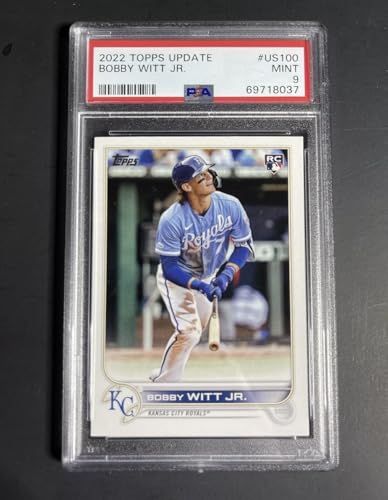
2022 Topps Update Bobby Witt Jr. Rookie RC #US100 PSA 9 MINT
1 owner reviews
2022 Topps Update Bobby Witt Jr. Rookie RC #US100 PSA 9 MINT.